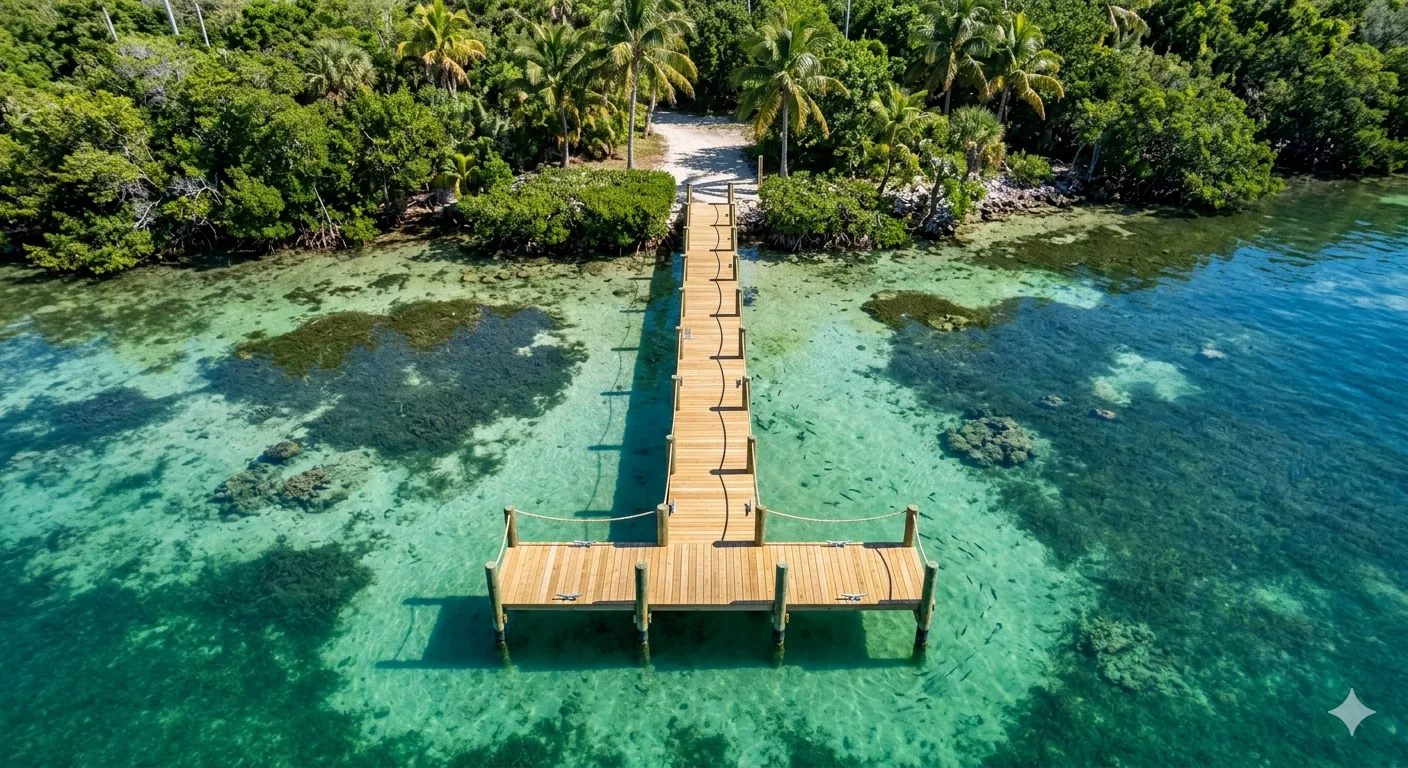
You can usually build a dock over seagrass in Tampa Bay, but it has to let light reach the grass. Under Florida's dock construction guidelines, a joint product of the Army Corps and the National Marine Fisheries Service (NMFS), a walkway over seagrass should be at least 5 feet above mean high water and no more than 4 feet wide, with gaps of at least ½ inch between deck boards and pilings at least 10 feet apart. Platforms belong in deeper water past the grass where possible, or are kept small and built from grated decking.
Why Seagrass Changes the Design
Seagrass needs sunlight, and a dock is a shadow that never moves. A study by the Army Corps' research center looked at docks built in Florida after the guidelines were adopted and compared light and seagrass under each dock with open water nearby. The guidelines exist to keep that shading small. In practice, regulators reviewing a Pinellas dock application look closely at height, width, orientation and decking when grass is present, and the county's Coastal Environmental Resource Zone map flags properties near seagrass and mangroves.
What the Guidelines Ask For
The Walkway
- Align the dock to cross as little seagrass as possible.
- Top of decking at least 5 feet above mean high water.
- Maximum width of 4 feet. Piers longer than 200 feet may have one turnaround at the midpoint, up to 10 feet long and 6 feet wide.
- Run the over-grass section north and south where practical, so the shadow sweeps across the bottom during the day instead of sitting in one place.
- Deck board gaps of at least ½ inch, and pilings through seagrass at least 10 feet on center.
The Platform at the End
- Put it in deeper water beyond the grass, or in a bare area, if you can.
- Over seagrass with grated decking: up to 160 square feet, at most 8 by 20 feet. At least a 5-by-20-foot section stays at the 5-foot height; a 3-foot-wide strip may step down to 3 feet above high water for boarding.
- Over seagrass with plank decking: up to 120 square feet, at most 6 by 20 feet.
Boat Lifts
One uncovered lift area is allowed, with a narrow catwalk on the outboard side and a walkway at the stern, kept at the 5-foot height.
Grated Decking
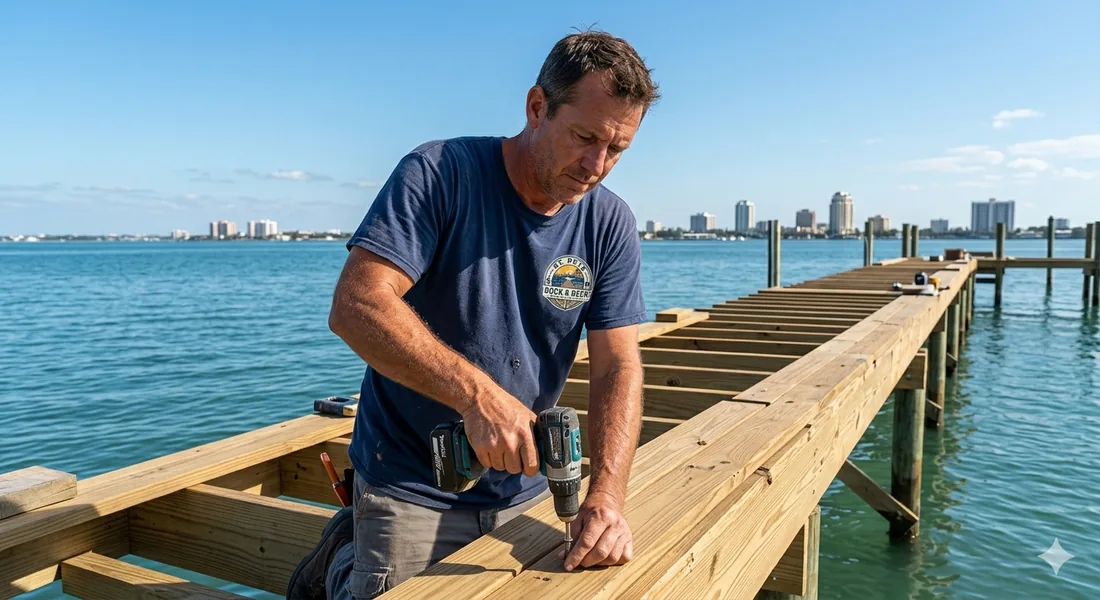
Grated panels are fiberglass or plastic grids that let far more light through than solid boards. They cost more than wood decking, but they can allow a larger platform over grass. Choose panels with a molded anti-slip surface and a load rating suited to how you will use the dock. We often combine a grated section over the grass with standard composite or wood decking near the seawall.
Mangroves Along the Shore
For docks through mangroves the same guidelines keep the walkway to 4 feet wide, limit clearing to the width of the pier and route it through the narrowest part of the fringe. Trimming mangroves in Pinellas County is regulated and has its own permit, so plan that with the dock.
Building Without Damaging the Bottom
The guidelines also say pilings should be installed so they do not leave mounds of sediment, the "halos" seen around some piles. Driving pilings is preferred; low-pressure jetting is allowed. That affects equipment and scheduling, and it is one reason over-grass docks can cost more per foot.
What This Means for Your Project
A taller, narrower dock needs more stairs at the seawall and a little more planning for boarding, but it keeps the walkway well above most high tides. If you are planning a new dock or a boat lift in St. Petersburg or Tierra Verde, we will check the resource map and design to the guidelines from the start. For the city side of the approval, see our St. Petersburg dock permit guide, and for lift planning, what size boat lift you need.